Thursday, July 9, 2015

Two More Classes for The World With No Name

I've found this custom XP guide made by Nick Peterson. It's made for Labyrinth Lord, but by changing it a bit, removing level limits from the calculation, and ignoring most limitations on armor, weapons, and magic items, I can create fairly balanced custom XP charts for all of my classes. I've calculated the two classes I made in my last class post for their XP, and here's what I got in the end:

The Puppet: 1,580 XP to reach level 2
The Goremaster: 2,020 XP to reach level 2

I've also created custom XP for the following two classes: The Aquatic and The Barber-Surgeon.

The Aquatic
Hit Dice: d8 (+2/level after 9th)
Attack Bonus: Equal to level
Saving Throws: as Elf
XP to Level 2: 2,080

You are a member of some underwater race. You might be a fishman, or a walking octopus, or a kappa, or the child of a union of piscine peoples and humans.


  • You can breathe underwater and on land.
  • You have a swim speed equal to your walking speed (120' when unencumbered)
  • You switch Constitution and Charisma, but only if Charisma is higher than Constitution
  • Your appearance is based on two rolls that function like the descriptors of a fighter (d10). If you roll two appearances that go against each other, keep the later one and re-roll the first.
    • Frog: Can jump great distances
    • Turtle: AC bonus of +2
    • Eel: Limbless. Has control over water.
    • Axolotl: Regenerates 1 HP every turn
    • Isopod: Can climb walls
    • Fish: Fangs or bite attack that deals 1d4 damage, using Strength
    • Octopus: Has multiple appendages (tentacles)
    • Whale: Is very large (-2 to hit small targets such as halflings), like 7 or 8 feet tall.
    • Tardigrade: Is very tiny (cannot use large weapons), has +2 to all saving throws
    • Crab: AC bonus of +1, claw attack (1d6, using Strength)

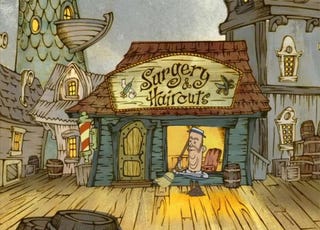
The Barber-Surgeon
Hit Dice: d6 (+2/level after 9th)
Attack Bonus: 1/2 level, rounded down
Saving Throws: as Magic-User
XP to Level 2: 1,250

You are a "doctor" who is skilled in the arts of bloodletting and amputation. You also are quite skilled with the scissors and the shampoo.

  • You can perform bloodletting that heals a number of d4s of HP equal to your level. This is done by making a Medicine skill check (the skill that this class is especially proficient in (begins at 3 in 10 chance)). If it succeeds, the HP rolled is added to the HP of whomever you are performing the procedure on. If it fails, the HP rolled is removed from the HP of whomever you are performing the procedure on.
  • In combat, you can roll a d6 to see if your attack severs a limb. This increases at the same rate as the Search skill of the Elf does in the rulebook. If the roll succeeds, then you roll 1d4 to determine which limb is amputated: 1-right arm, 2-left arm, 3-right leg, 4-left leg. If a one is rolled, then the head of the enemy is removed, killing them instantly.
  • You can create an anesthetic that can knock out someone for a number of minutes equal to your level. This costs 200 SP, and gives you bonus time for every additional 100 SP spent on it. The additional time is equal to 1/2 your level (30 seconds at level 1). The victim gets a save vs. Paralysis to combat it.


Babel, The Tower Of Spirits

In the seas toward the equator of the world, there juts forth a great tower. It is the only above-water sign of an ancient civilization that lived here once, before their resplendent metropolis was sucked beneath the waves. This structure was their greatest achievement, for it grew so high so as to break into the heavens themselves. When the rest of their magnificent empire fell beneath the ocean, this great tower still stood, and still stands today, as a testament to the powers and knowledge of that great nation, for no others have been able to construct such a tower.

The peoples of the islands that surround this tower want some of that knowledge and power. They will pay nearly anything to have folks who hold their lives in less regard delve into the unknown depths of this tower and retrieve the ancient artifacts and knowledge of the long-dead empire.

And you really must have almost no regard for your life and for your safety to enter the tower. In the centuries and millennia since it fell, it has become overrun with monsters and creatures of all sorts. The upper levels, those that force themselves into the void of heaven, are filled with all sorts of alien creatures, such as angels. The lower levels, those that are beneath the waves, have become overrun with sea devils and other oceanic monsters. These creatures, along with those constructs and beasts left over by the ancient civilization, mutated or eroded by the forces brought into the structure, guard the secrets of the ancient peoples.

Essentially, this is a megadungeon concept that becomes more dangerous the higher up and the lower down you go, rather than just in one direction. Some specific factions, items, and monsters that might be found in Babel, The Tower Of Spirits are detailed below.

Normal DnD Creatures in Babel
The rats here are like fish. Or they are like light. Mundane creatures look more normal the closer to the center of the tower they are, but the lower down or the higher up you go, you will find that they have changed to suit the environment. In the lowest levels, the rats look like quadrupedal fish with unblinking eyes and toothy maws. In the highest levels, the rats look like balls of light with four spindly legs. Mostly, you will just use the same statistics, but switch out appearances.

The zombies that are low down are bloated with water and the skeletons are covered with kelp and sea stars. Vampires have eyes of black and mouths like lampreys and can become goblin sharks or clouds of hagfish slime. In the upper levels, zombies are the corpses of those who have died, possessed by space ghosts or alien energies. They do not decay because of the alien effect on their flesh. Those upper levels have additional shadows even in places where light shines. Vampires of these upper levels are featureless and smooth, until they open their mouth and you see a hole ringed with teeth of glass.

Cephalopoid mind flayers hide in the darker corners of the lower levels, and eye-covered beholders float through the halls of the upper levels.

Not Normal DnD Creatures in Babel
Angels live in the higher levels. They are made of rings of gold and balls of fire. They are covered in circles of eyes and limbs of animals. They speak only in the language that the stars throw at each other in the voids between them. These are spirits of order whose goals are harmful to meaty creatures such as humans, for flesh is chaotic and disorderly. They can take forms of meat, but only do so begrudgingly, and they remove creatures from their prisons of meat to bring them in contact with the greater order of the universe. They fall into orders, levels, and circles, and each celestial being has a role and a place. (angels will be described more in-depth in another post)

Saratan, the great crab, controls one of the lower levels. They are the size of an island, and on their back there lives a culture of piscine peoples.

Alien fungi and extraterrestrial flora grow on the higher levels. Those who breathe in the spores and the pollen contract unknown diseases and alien allergies, and some might become the mold-controlled puppets called Spore Cosmonauts.

Some fish and other ocean animals have adapted themselves for the slightly less wet corridors and rooms of the lower levels. These are angler fish that crawl around on the ceilings and floors of the tower and octopi that bound along, hunting anything they near.

Factions of The Islands
A cult that worships the fish gods Father Dagon and Mother Hydra want artifacts and creatures from the lower levels. Some even say that their gods dwell in the deepest parts of the tower, and they will pay ludicrously to bring some of them to these piscine deities.

A church of Bog wishes for more information about the kingdoms of heaven and about the nature of Bog. If you retrieve information about either of those things from a bonafide angel, they will pay you handsomely. They would also totally be down to get some holy relics to treasure or unholy false idols to destroy.

A slave ship has arrived recently. The people here consider slavery horrible, for it infringes upon the freedoms of the people, but they don't consider the fish folk people, so they're completely fine if you kidnap some fish people from the tower and sell them to the slavers. The slavers will pay additional money for aquatics, as they can work in underwater environments.

There is a wizard that requires the ichors and the parts of angels for spells that they are working on. They will reward with not just silver, but also with the spells and magical items themselves, if you promise not to share them too much.

The tribe on a small island near the tower considers it to be the home of their god. They hate their god. If you can bring back the head of their god, they will reward you with fame and honor, as well as a high standing in the tribe.

Friday, July 3, 2015

Four Undead

The Zombi and The Skeleton
The zombi and the skeleton are two creatures most commonly created by necromancers. They are both created using the same sort of vile magick, with the only difference being the level of decomposition present in the walking cadaver. Zombis can even be made from living people, though once they are under the necromancer's control, there is almost no way to get them back.

The consciousness of a zombi or of a skeleton is under the control of the necromancer, and thus, these creatures have no amount of self preservation. If they catch on fire, they will keep on kicking until the last piece of ash is blown away in the wind. If all that is left of a zombi is a pile of viscera, the bloody pulp will ooze along, still going at its task. Even if the brain of the zombi is removed from its body, the necromancer will retain control of both parts, and you have just made a slow cerebral ooze and a stumbling walking corpse. The only way to defeat a zombi or a skeleton is to completely destroy every single part of it. Just getting it down to 0 HP isn't going to cut it.

Even though the necromancer has control over the body of the undead creature, occasionally the real consciousness of the body will break through. You might hear it scream for help or suddenly run away from you before walking back at you. If the necromancer dies, the zombis and skeletons that now control their own bodies will try to enact vengeance on the bokor, and might burn the body, eat it, or simply tear it limb from limb. However, they are still definitely affected by their time under the control of the wizard, and so they have to resist every urge to devolve into a mindless walking corpse.

The Ghoul and The Ghast
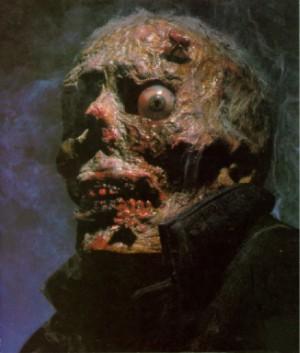
Ghouls are created by a terrible plague that makes you into a horrible cannibalistic monster (called the Cannibal's Illness). It slowly makes you into an almost human monster that only wishes to gorge itself on meat. Your eyes glaze over and you forget about who you once were. You become an immortal abomination filled with disease and decay, and every injury just causes you to become more monstrous and mutated.

Something cuts off your arm, and you regrow an arm that is almost a good arm, but not quite. Meanwhile, your arm that was once connected to your body grows into a smaller ghoul that just has a huge arm. Both of these monsters are you. If you are cut in half, each side regrows the other side, but it might be covered in tumors or eyes or teeth. Your heart is ripped from your body, and it just grows spindly legs from your veins, and crawls on the ground, spitting ghoul blood on everything. A new ghoul might look like someone who just needs a shower or a bandage or two. An old ghoul is covered in tumors and veins, with two blind heads and a mouth filled with almost shark-like teeth.
By Jonathan Wojcik of Bogleech, for his upcoming game Mortasheen!

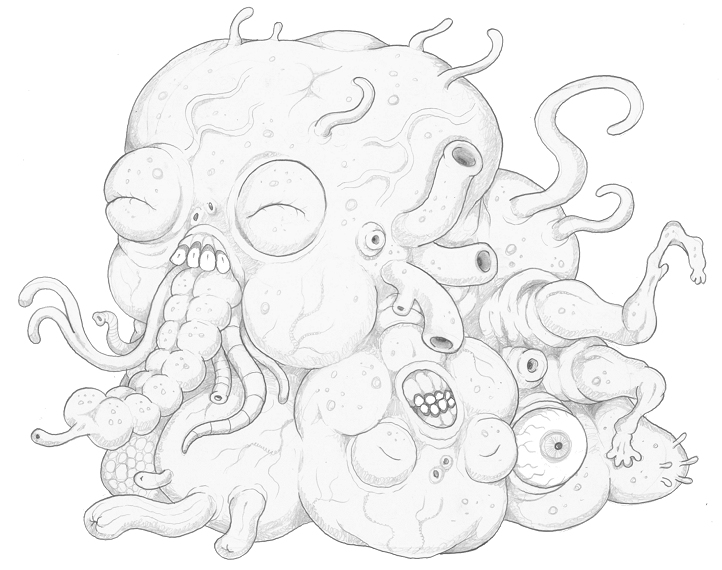
Ghouls might remember a thing or two of their life as a human. They might remember taxes, or the king, or they might remember children. They might even remember how to make them! If a ghoul tries to reproduce with another decaying abomination, it will probably work. It won't produce a normal baby, and it won't produce a really small ghoul. No, reproduction between these undead monsters creates the strange creatures known as ghasts. These monsters might look like a deformed baby, or they might look like a huge embryonic dragon-like beast. Crawling mountains of conjoined fetuses, hive-like infants filled with parasitic flies, anencephalic gremlins, and even more diversity of these undead descendants are produced when two or more ghouls try to make a child.
Also by Jonathan Wojcik for Mortasheen

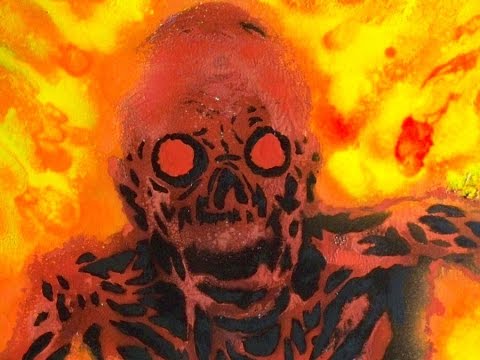
If you have contracted the Cannibal's Illness and are not yet a ghoul, you are what is called a half-ghoul. You will forget you family and friends and your life before you started becoming an undead monstrosity. You will be overcome with the urge to eat constantly, and only ever eat meat. Plants and other foods will turn to sand, mud, or dirt on your tongue. Slowly, you will lose all thought beyond eat, and eventually you will become a ghoul.
Also for Mortasheen

Friday, June 26, 2015

Two Classes for the World With No Name

Eventually, you might look like Oogie Boogie

The Puppet
Hit Dice: d6 (+2/level after 9th)
Experience: as Thief
Attack Bonus: 1/2 level, rounded down
Saving Throws: as Cleric

It is well known that creatures in groups form consciousnesses together. That's why ants and bees can do such coordinated tasks, and why sometimes people dream the same dream. The puppet is an example of this. It is a human or otherwise humanoid skin that is puppeted around by insects, arachnids, or some other type of small creature. You begin with only a small amount of these animals, but the number increases as you go up with level, and the creatures attract more of their sort. Puppet characters have the following class features:

  • You have a number of puppeteers equal to your HP.
  • When you have fewer creatures, you are lighter and speedier. Your exploration speed is 140', and you switch your Dexterity and Strength scores, but only if Strength is higher than Dexterity.
  • For every 5 creatures above 6, remove 1 point from Dexterity and put it into Strength. Your speed also decreases; it goes down by 10' every 4 levels (5th level, 9th level, etc.)
  • You can send your controllers to go on missions such as spying. For every puppeteer sent out, you lose 1 HP.
  • Magical healing kills any controller creatures that are away from your body and births new ones in your skin.
  • You can use your puppeteers for some tasks that are more specific than what can be done as stated above:
    • You can use the Tinker skill as a Thief of equal level. This is affected by your Dex modifier.
    • You can use the Sleight of Hand skill as a Thief of equal level. This is affected by your Dex modifier.
    • You can take control of another creature by sending a number of creatures equal to its HD+5 into it. It must make a save vs. paralysis to resist the effect. For each bonus Hit Point, you must send in another creature.
  • You have +1 to both your Paralysis and Poison saves, and +5 to your breath save. However, for every 6 creatures controlling your hollow skin, you receive a -1 penalty to your Breath saving throw.

With some work, you might look like the Tarman

The Goremaster
Hit Dice: d8 (+3/level after 9th)
Experience: as Fighter
Attack Bonus: 1/2 level, rounded up
Saving Throws: as Fighter

You are a walking car accident or murder scene. You revel in injury and viscera, and have no reaction to harm, unless you love it. You might look normal now, but you can just fill the area with your blood and guts at a moment's notice. How is unknown, but you can! Goremaster characters have the following class features:
  • At level 1, you take 1 point less damage from nonmagical sources (fire, weapons, etc.). However, you are still injured by them. They just don't faze you. At level 3, you take 2 fewer points of damage. At level 6, you take minimum damage from nonmagical sources, and 1 point less damage from magical sources.
  • At level 1, you can explode yourself. Everybody within 30' is splatted with your blood and viscera and must make a save vs. paralysis or faint/puke for 1d6 rounds. You reform after 1 round, at an amount of HP equal to your HD plus your Con mod (minimum 1).
  • At level 6, you can control the flesh within other creature's bodies. Thus, you can make them explode just like you. However, they don't reform unless you make them. If you try to kill them, they can make a save vs. magic, with a penalty equal to your level, minus 5. At first, you can only control the flesh of creatures within 10', but it increases by 5' every level.
  • At level 9, you can animate other people's flesh into semi-autonomous gore constructs. They have HD equal to the creature they were made from, AC equal to them when unarmored, 1 attack (1d8), and saves as a fighter of your level. 
  • If you are not wearing armor, your AC is equal to 10+Dex mod+Con mod. If you are not wearing skin, you have a variable bonus, based on what your AC is unarmored:
    • 10-12: +6
    • 13-14: +4
    • 15-16: +2
  • You have +2 to your Paralysis and Poison saves.

Thursday, June 25, 2015

Towards More Interesting Bandits

Bandits
Bandit tribes and gangs should have evocative names and interesting subcultures and whatnot. Essentially, I'm just gonna share some bandit tribes that I came up with earlier today for a hexcrawl I'm working on, as well as some new ones. The base stats for the Bandit are:

HD: 1
AC: 14
Attacks: 1 (weapon)
Damage: Varies by weapon (typical weapon is listed with bandit tribe description)
Movement: 120'
Intellect: 9-12
Morale: 7
If bandits are found traveling, then you will encounter 2d6 of them. If they are found at their own camp, you will encounter 3d10 of them. Other special features are based on their tribe/gang.

Some Bandit Tribes
The Bloodies: They drench themselves with blood before fighting. If fighting without blood on their body, they have -2 to all of their rolls. They typically arm themselves with swords (1d6+2).
The Eye-Gougers: They gouge their eyes out with knives. Some wear eyepatches or blindfolds. They have -4 to hit with attacks, but attacks deal double damage (1d4 becomes 2d4). They arm themselves with knives (1d4)
The Biters: They crawl on fours, completely naked, and attack by biting, rather than using weapons. They have +4 to hit with their bite attack (1d6), and have +1 to hit with all other attacks. Some might think they are druids.
The Garbage Men: They cover themselves with trash and other rotting things. Creatures around them must succeed a save vs. paralysis or fall unconscious because of the stench for 1d4 rounds. They typically carry clubs (1d6+1)
The Crack Heads: They break open their skulls and let the brains within be free for at least a few moments. Every round, they must make a Con check (con is 2d6+6) or fall unconscious for 1d6 rounds. They can cast spells as a level 1d6+1 MU. They are armed with clubs (1d6+1)
The Chains: They wrap rusty chains around their body that can snatch people from wear they stand. When they make an attack, they can choose to forego the attack and instead wrap the target up in the chains. The target must make an opposed Strength check every round to escape (bandit strength is 4d6, drop the lowest). They typically carry knives (1d4)
The Drunkards: They fill themselves with booze before fighting. When drunk, they have -1 to their AC and attack rolls, but +5 to all of their saving throws. They carry broken bottles (1d4+2).
The Ghouls: They are emaciated, almost undead-looking. During combat, they can eat a corpse to gain the attack bonus, AC, and saving throws of the dead person for the next hour. They attack with their claws (1d6+1)
The Gemini: They are tied together with ropes and tubes that share their blood. All of their statistics are doubled (except for AC and speed) (thus, they have 2 HD, 2 attacks per round, etc.). Some of them are actually connected by flesh.
The Highwaymen: They wear elaborate costumes and strange guises. In addition to their normal stats, they have the abilities of a level 2d4 thief. They can backstab and use burglary skills.
The Turtles: They have thick shells or carapaces strapped to their backs. As an action, they can retract into these shells. The shell has AC 18, but their body is still AC 14. The shell has 2d6 HP.
The Stilt Storks: They strap their legs on thin, yet strong, stilts so that they can be above the people they are fighting. The legs must be broken before you can attack the bandits in melee. They have AC 16 and 3d6 HP.

Monday, June 22, 2015

Orcs


Orcs are bad news, but they can be talked to. Elves are alien and will murder and burn with reckless abandon, no matter what you say. Orcs can be reasoned with. Orcs have families and children. Even though they do have a culture of violence and don't understand death, they are much more likely to not kill you and your family if you talk to them.

Orcs worship gods that are constantly warring. Their priests drape themselves with bloody spines and crawl through the remains of battles, reading the future through the gore and viscera. All orcs carry weapons, except for the infants, who hunt with their claws and their fangs. Orc currency is skulls and teeth that they take from corpses and their fellow orcs. They make goblins work for them with intimidation, but still treat them better than humans do. They are allies with the hobgoblins, and orchestrate great war campaigns.

Orcs are obsessed with violence, but they see it as more of a game. They think that after they die, they are reborn as another orc, ready to crawl through the gore and claw at anything it sees with its new baby claws. They see death as only an obstacle, and the orc afterlife is either a gauntlet of combat that you must fight through to come back to life (if you were a good orc and murdered as many people and things as you could) or a small village, filled with seemingly friendly people who are actually extremely judging and prejudiced. You must survive in that hell of toxic people with no murder and arson for a few years, and then you come back.

Since orcs are actually extremely innocent and trusting, but love violence and war, they are taken advantage of my more tactically-minded creatures, such as hobgoblins. Even though the Church of Bog has made it so that most people today regard the orcs as some verminous sort of human, many past human societies, as well as non-Boggian cultures throughout the world, graciously accept orcs into their armies and societies. However, special systems have to be made to make sure that these orcs do not kill and burn things that they don't want killed and burned, and so they are usually drafted as low-level cannon fodder in armies, or as gladiators in arenas, where they can be told what things are okay to destroy easily. If an orc child is brought up in another society, they will become like a normal member of that culture, but when an infant they will still hunt for food. There are several cases of elves stealing orc babies and beating them into some unstoppable military force. And by beating, I mean literally beating and abusing them to do their terrible bidding.

Orcs are actually much nicer than the dwarfs and those human cultures touched by the Church of Bog. If you encounter them, they will probably help you if you are in danger, or accompany you through the wilderness. You just have to get used to them catching themselves on fire or storing their swords in their torso and be accompanied by the frenzied, cannibalistic infant orcs.

Orcs never stop growing. Some of the older orcs reach heights of 10 feet or higher, and some rumor that there are 25 foot tall orcs that fight dragons and giants deep in the wilderness.

The Orc (Race)
Class Restrictions Orcs can play every class
Special Abilities Orcs have the following special abilities and features:

  • +Strength, -Intelligence (orcs switch their Strength and Intelligence scores, but only if Intelligence is higher than Strength)
  • When you reach 0 HP, you can choose to go back up to 1 HP, rather than making the saving throw. You gain an injury from doing this, however. This can only be done once per day.
  • Your attack bonus is equal to half your level, rounded up, rather than what is normally indicated for your class (unless you are playing a fighter).
  • Orcs save at +3 to paralysis and +4 to poison.
The Orc (Monster)
HD: 1+1
AC: 16
Attacks: 1
Damage: 1d6+2
Movement: 120'
Intellect: 4-7
Morale: 7
The typical orc will have the abilities of a level 2 fighter. 50% of all orcs will be of the typical variety, with 15% being higher level fighting-types, 15% being clerical types, 15% being magic-users, and 5% being of the thief class. They will almost always be found in groups, accompanied by baby orcs, as well as goblins. They will almost never check morale, only if there is extreme danger.
A very dirty baby orc. Just give it sharp teeth.

Orc, Baby
HD: 1-1
AC: 14
Attacks: 2 (claw/claw or claw/bite)
Damage: 1d4 claw, 1d6 bite
Movement: 115'
Intellect: 3
Morale: 12
Their claw attack has a +3 bonus to hit, and their bite attack has a +2 bonus to hit. They never, ever check morale, and will only run away if taken by the older orcs. They can climb up walls at the same speed that they can crawl on the ground. These orcs are much more likely to be found alone, but their presence typically heralds a camp of orcs not too far away.

Wednesday, June 17, 2015

Elves


Elves are bad news. They will steal your children, make your crops shrivel, and curse your body. They will crawl into your house at night and murder everyone but you, redecorating with their viscera. It is easy to find an elf because of the trail of disease, discord, gore, and ruin that they leave behind them. Or it will be impossible to find an elf because they hide themselves just outside of your vision. If you meet an elf, you will know. They look human in outline, but they are definitely not human. Their eyes might have slit pupils, or no pupils at all. Their mouth might just have the small cutting teeth of a child, or they might have layers upon layers of needles. They might bleed oil that glows in darkness, or hunts creatures as if it were an ooze. They might have the horns of a goat or the antlers of a stag. They might have the tail of a cow or of a monkey, or scales like a reptile or a fish. They might have cracks in their skin, or skin like porcelain, obsidian, tree bark, or metal. Elves are monsters.
A family of elves

Elves are faerie creatures. All fae are horrible, but elves are just some of the most numerous. There are many things that are the bane of elf-kind. Iron and salt destroy their being as well as their flesh, and certain charms have strange effects on them. Elves are confused by faith, just as they are confused by other things of the more mortal world, but they fear clerics. That's because they know that whatever god or spirit the priest is praying to doesn't exist, but they get seemingly limitless, miraculous power from their belief in them and their confidence alone. Clerics are possibly the only thing that elves fear.

Elves might do terrible things, but they aren't evil. They are just alien. They have a complete disregard for more mortal life, and especially human life. They do not care. They only see you as something to be toyed with for their enjoyment.

While everybody knows that elves are dangerous, they don't often know that their animals are dangerous too. If an elf is riding a horse, its probably a unicorn. If an elf is accompanied by a dog, its probably a Coo Sidhe (Coo Shee). The flies around an elf's head are piskies, and the cat is a strange familiar.

The Elf (Class)
The elf is exactly the same as in the normal LotFP rules, but with the following changes:

  • The spellcasting change elaborated in this post.
  • They take 1.5 times more damage from iron weapons.
  • They take 1 point of damage from salt.
  • They take 1 point of damage for every point above 10 from iron armor.
  • If you choose iron armor/weapons or an animal at character creation, rather than being normal, there are the following changes:
    • Iron tools are made from the strange elfmetal (also called mithril)
    • Horses are unicorns with hit dice 3+3
    • Dogs are Coo Sidhe
  • You don't need to eat, but you really like eating, so you drain the food supplies as normal.
  • You don't need to sleep (see below)
  • You can go into the world of faerie at-will. This (sort of) replaces sleep, as if you stay in the more mortal world, you become less magical and more mortal, losing your magical powers. The more you become mortal, the more difficult it is to go into faerie.
  • They cast spells from their own spell list, rather than the MU spell list.
  • They are able to see in darkness.
  • + Charisma, - Constitution (they switch their Int and Con scores if Con is higher than Int)

The Elf (Monster)
HD: 1+1
AC: 14
Attacks: 1
Damage: 1d8+1
Movement: 120'
Intellect: 16-18
Morale: 10
The average elf will have the abilities of a level 3 elf. If they are accompanied by animals, they will be monstrous (horses will be unicorns, dogs will be Coo Sidhe). There is a 65% chance that they will be of a higher or lower level than third. They will only check morale if the cleric in the party prays for a miracle. They will attack with daggers typically, but they can employ their claws, which deal 1d6+1 damage. Both attacks have +2 to hit, unless they are a higher or lower level.