Showing posts with label Dungeons and Dragons. Show all posts

Sunday, September 18, 2016

Batrachians and Beezlebubs

Two similar yet opposed classes for the old school rpg of your choice (though I sort of assume LotFP).

The Frog Demon
d8 Hit Dice (6 hp at level 1)
Attack Bonus: as cleric (I use 1/2 level, rounded up)
Saving Throws: as elf
Experience Progression: as elf

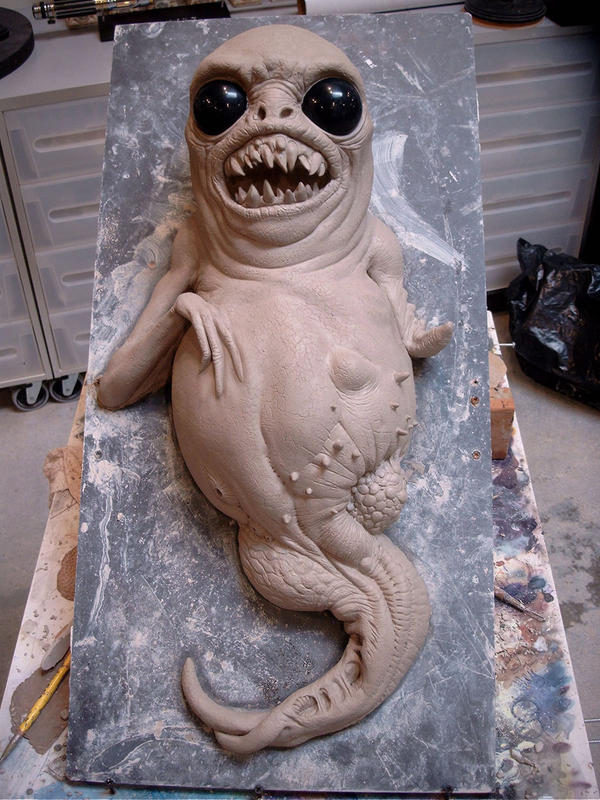
At level one, you are a fledgling frog demon who is really only a simple tadpole, able to manipulate objects with your mouth and able to swim and breathe in both air and water. In addition, you have a single cultist follower who you can order to do things for you. You gain 1 new cultist follower each level, and can gain more through normal hireling means and by converting people to your worship. If any of your cultist followers die, they are "refilled" back up to the minimum number you can have, which is equal to your level, the next day. You are able to speak with all frog creatures.

At level 2, in addition to the cultist follower that you gain, you grow legs and the ability to jump great distances.

At level 4, in addition to the cultist follower that you gain, you become a fully-grown frog demon. You are able to control normal frogs, and have a special tongue ability that allows you to grab a creature or object from a distance and pull it towards you. This functions as an opposed roll, with both you (the frog demon) and the victim rolling 1d20 and adding your attack bonuses. Both you and the victim add their STR bonus to the roll in addition to the attack bonus, and the one who rolls higher wins. Arthropod targets get a -2 to their roll.

At level 6, in addition to the cultist follower that you gain, you gain the ability to turn your cultist followers into frog monsters. You can do this once per day, increasing by 1 extra use for every level above 6. You simply point at the cultist which you are gracing with a better, slimier, amphibian form, and their body contorts and mutates into some sort of frog monster. The exact appearance is up to you, but the creature always has the same stats: 1+1 HD, +1 attack bonus, 14 AC, 1d8+1 damage. You are able to spend more than 1 "use" to increase the stats of the creature, increasing all stats by one increment (2+1 HD, +2 attack bonus, 15 AC, 1d10+1 damage, etc). All frog monsters use your saving throws rather than their own.

The Fly Demon
d6 Hit Dice
Attack Bonus: as thief (1/2 level, rounded up)
Saving Throws: as fighter
Experience: as elf

At level one, you are a little baby beezlebub, nothing more than a fat giant maggot. You can manipulate some objects with your mouth, and can crawl upon the ground. You can also use your tusk-like mouthparts to dig through certain materials, especially meat. You follow the same cultist follower rules as the frog demon above, and so begin play with 1 cultist.

At level 2, in addition to the cultist follower you gain, you begin to go inside of your pupa, and thus cannot interact with the world in any way. However, you float in the air and are able to communicate with the minds of your followers. You are considered as having an armor class of 9, but always take 2 fewer point of damage than normal, and your followers will probably protect you.

At level 4, you crawl out of your pupa as a fully-formed adult fly. You are able to fly in the air, control flies of all life stages (maggot, pupa, and adult), and gain an acid-vomit ability. Your acidic vomit deals 1d6 damage, and can deal more damage (or have some additional effect) if you have consumed some sort of special food recently. However, you lose the points of armor and low armor class from your pupal stage of development.

At level 6, in addition to the cultist follower you gain, you obtain the ability to turn your cultists into either fly monsters at some stage of a fly's life cycle, a swarm of flies or maggots, or a strange mutated fusion of human and fly. You can do this once per day, increasing by 1 additional use each level above 6. You point at one of your cultists, and their skin begins to split as a fly or fly mutant pulls itself out, or they burst into a swarm of flies or maggots. The exact appearance is up to you, but the statistics are always the same: 1 HD, +3 attack bonus, 14 AC, 1d6+1 damage. You are also able to spend additional "uses" to increase the stats (2 HD, +4 attack, 15 AC, 1d8+1 damage, etc.) All such fly creatures use your saving throws.

Saturday, May 23, 2015

The Cancer Mage


The Cancer Mage (Pestilence Arcane Tradition)
Class: Wizard

Pestilence Savant
Beginning when you select this arcane tradition at 2nd level, the gold and time you must spend to copy spells from the Cancer Mage spell list into your spell book is halved.

Plagued Nature
Starting at 2nd level, you are immune to all diseases, and become a carrier of them. No disease ever leaves you, and your face and skin are covered in boils, lesions, and pus-filled sores. Your every breathe carries innumerable plagues and ills, and when someone attempts to remove the diseases from you, either through magic or medicine, they are harmed, taking 1d4 poison damage for every wizard level you have.

Cancerous Companion
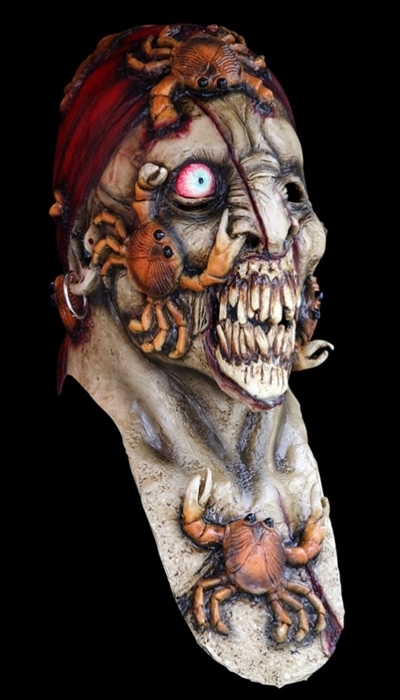
Starting at 6th level, you grow an intelligent teratoma somewhere on your body. It can painlessly tear itself from your body and walk around, being unable to attack, but being able to communicate telepathically with its cancer mage. If you are using another spell that functions like this, such as Beast Sense, this functions in conjuction with that.

Infected Wounds
Starting at 10th level, your attacks infect others with the plague and pestilence you carry. This affects both physical and spell attacks. Your attacks infect the target with 1 random disease that you are carrying.

Disease Form
Starting at 17th level, you can take the form of an illness. You will not be able to be detected in any way, except by those with exceptional scent. When infecting someone, they must make a constitution saving throw, and if they fail you take complete control over their actions. You can remain in this disease form for as long as you wish, but you will be affected by medicine and magical healing done on the host individual. When in plague form, you do not need to eat, sleep, breathe, and do not age.

List of Cancer Mage Spells
The following spells count for the Pestilence Savant class feature described above. (spells listed below that are not on the wizard spell list are added for this reason)

Cantrips
Acid Splash
Chill Touch
Mending
Massage
Poison Spray

1st Level
Detect Magic
Disguise Self
False Life
Find Familiar
Grease
Insect Armor (functions as mage armor)
Ray of Sickness
Tasha's Hideous Laughter
Witch Bolt

2nd Level
Alter Self
Beast Sense
Blindness/Deafness
Crown of Madness
Enlarge/Reduce
Hold Person
Melf's Acid Arrow
Ray of Enfeeblement
Spider Climb
Web

3rd Level
Animate Dead
Bestow Curse
Fear
Feign Death
Gaseous Form
Nondetection
Protection from Energy
Stinking Cloud
Tongues
Vampiric Touch

4th Level
Blight
Confusion
Control Water
Evard's Black Tentacles
Fabricate
Giant Insect
Locate Creature
Phantasmal Killer
Polymorph

5th Level
Creation
Dominate Person
Dream
Geas
Hold Monster
Insect Plague
Modify Memory

6th Level
Circle of Death
Create Undead
Disintegrate
Drawmij's Instant Summons
Eyebite
Stone to Flesh

7th Level
Finger of Death
Simulacrum

8th Level
Antipathy/Sympathy
Clone
Control Weather
Feeblemind
Mind Blank
Power Word Stun

9th Level
Power Word Kill
Shapechange
True Polymorph
Weird

Saturday, March 21, 2015

Classes of the Supernatural Earth: The Barbarian

I use all classes in the DnD 5e Player's Handbook in the Supernatural Earth game. Each class will be dealt with separately in their own post, beginning with this one.


Barbarians are folk who follow ancient codes and rules from times of yore, passed down through generations or discovered recently, originating from supposedly "primitive" or "vulgar" groups of people. In exchange for following these ancient codes, they are given power over anger and rage by the spirits of their predecessors, being able to calm their emotions quicker than most, and to go into an uncontrollable rage that heightens their senses and strengthens their limbs.


Barbarians of the Path of the Berserker follow the rulings of the Mongol Hordes of Asia or the Berserker Norsemen. Those barbarians that follow this path gain even more control over their emotions, and the rage that they enter is stronger than the rage of a normal barbarian. There are many different varieties of berserkers, with some being very vulgar and violent, and others using their control over their emotions to become enlightened and stronger emotionally as well as physically.

Barbarians of the Path of the Totem Warrior follow codes made by Celtic Pagans or stolen from Native North Americans. For following the codes, they gain powers from a spirit in nature, usually in the form of an animal. They carry totems or fetishes, and though their rages weaken, they gain new powers in exchange.

Though they and the cultures they descend from are called barbarians by many, not many of them are barbaric. Another important note is that barbarians typically follow the codes of cultures they are descended from, so those descended from Mongols will follow the rulings of Mongol culture to gain their powers, and Celts follow their codes to gain their powers.

Tuesday, March 17, 2015

The Races of The Megadungeon Part 2

I forgot to say this in the last one, but those first three are the only playable races at the very start of the game, and all following races either have to be discovered or are not playable.

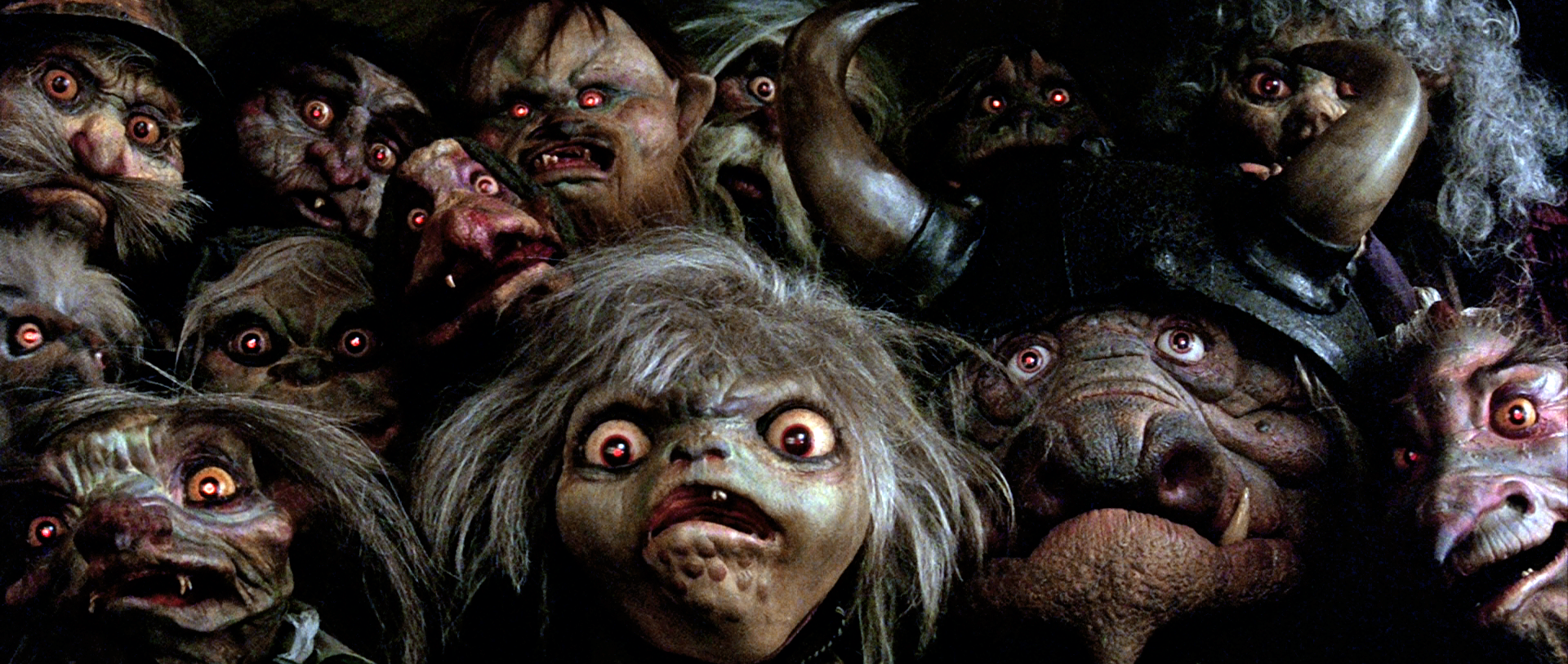
From Brian Froud and Jim Henson's movie Labyrinth
Goblins
Goblins are an incredibly populous and varied race commonly treated as a necessary evil by some, and as vermin by others. They are common enough in the nations and empires of humanity, but people, specifically humans, generally mistreat them. Nobody truthfully knows how they came to be, but there are many theories. Some say that they were mortal creatures spawned by a fae creature called the Goblin King from root vegetables such as turnips and carrots, while others, mostly clergy members, just say that they are unnatural abominations, probably descended from demons or something. They spoke of the race of orcs before humanity was introduced to them, and they claim that they were the creators of them. They are related to the race of hobgoblins.

Hobgoblins
Similarly varied, the stronger, taller, and rarer hobgoblins are generally treated as horrible brutes, and when people accept for jobs at all, they are almost always that of the more violent types, such as mercenary, soldier, or bodyguard. The first hobgoblins came into human-controlled lands from outside, and it is unknown where or why they appeared within humanity's land. They also spoke of the orcs before humanity was introduced to them, but they spoke of them more as equals rather than the way of the goblins, which was more like servants or slaves. When questioned about the creation of the orcs, they attempt to avoid the question, but always agree with the goblins about their origins. Nobody knows the origin of the hobgoblins, just like the race of goblins, and most theories stem from the theories for the goblins: they were grown from pumpkins or trees by the Goblin King, or they are stronger demons.

Orcs
Orcs were not known to the empires and nations of humanity until after they arrived in the New World to explore the Megadungeon. They are just as varied as both the races of goblins and hobgoblins. Although it is universally agreed that the goblins created the orcs, what is not agreed upon is exactly how they were created. Even the goblins never want to talk about it, simply continuing to brag about their creation of them rather than actually speaking of how they were made. People theorize about this too: the Great Church states that orcs were made from humans, possessed by demons in some foul ritual, distorted and mangled from their previously normal form. Some people say they were mutated from farm animals and wildlife with magick, citing some orc's bestial features. Some say that they crafted in cauldrons or pools by goblin witches, servants of the Goblin King, but what they are crafted from varies (some say humans, others say they are made from corpses and the beasts consuming them). The orcs themselves hate to be reminded of their creation, and always try to change the subject.

Monday, March 16, 2015

The Races of The Megadungeon Part 1


Humans
Humans have many nations and empires in the Old World, and their countries were the first to discover the New World and the Megadungeon. They founded the Great Church, and they "discovered" the race of the halflings. According to them, they are the most natural race, and so are the race that all other races are compared to.

Dwarfs
Dwarfs used to control vast swathes of land, both above and below the ground, with their immense empires. In the superstitions of many past human settlements, dwarfs controlled all that was below the ground. However, for some unknown reason, all of the empires of the dwarfs fell, leaving behind great ruins of keeps and castles. Of the dwarfs that existed, most are either dead or insane and delusional. The very few dwarfs that aren't one or the other are adventurers, not because of any grand reason, but because dwarfs really like money, and it is said that there are great treasures in the Megadungeon. Dwarfs are inherently non-magical, being unable to learn the arcane secrets of wizardly magic, but they have innate capabilities that are unknown even to them.


Halflings
The halfling people were "discovered" by humans living deep within dark and dank jungles, worshiping things labeled as demons by the Great Church and living in huts on stilts. The human nations took in the "primitives" and "uplifted" them, removing them from their tropical homes and forcibly making them join the "modern" nations. According to many, halflings will steal anything not nailed down, and it is a well known fact that they have unnatural agility and reflexes, due to the strange nature of the halflings' muscles and bones. Many halflings speak of more halflings in distant jungles and forests.

Saturday, March 14, 2015

Alignment in The Megadungeon

In the world of the Megadungeon, there are three alignments: Lawful, Neutral, and Chaotic. They are based upon how the cosmos feels about you, and so your alignment does not affect your behavior, or vice versa. Remember that law does not mean good, and chaos does not mean evil.

Light and Dark
During the day, law has more power on our neutral world. The Great God of Order can affect creatures and places, and clerical magic functions more. Entities from the stars of order can descend down onto the Earth easier, and most people treat this as though this time is when things are good.

During the night, chaos has more power on our neutral world. Demons and faeries are more prevalent, and wizardly magic functions more. Entities from the stars of chaos can descend down onto the Earth easier, and most people treat this as though this time is when things are bad.

In the cosmos, the most lawful place is the sun, and the most chaotic place is the moon.

That is why vampires burn in sunlight, demon worshipers live underground and in the dark and dank jungles, and the studies of wizards are lit only by flickering candles. That is why every mob of peasants is armed with torches when hunting after unnatural creatures, and children are afraid of the dark.

That is how it works in the Old World. In the New World and the Megadungeon, chaos has more power than law all the time, but the power of law does increase during the day. However, the power of chaos increases during the night too.

The Great Church
The Great Church states that only things related to The Great God of Order are lawful, and also that anything that any clergy member says is automatically lawful. According to them, anything not sanctioned by The Great Church itself is either insignificant or completely and utterly chaotic and thus, horrible and unnatural. Occasionally, they even say that creatures or occurrences of law are actually the forces of chaos, such as some of the alien horrors hailing from the stars of order or the sun.

The Petty Gods
There are innumerable petty gods found in both the Old and New Worlds. According to The Great Church, they are horrible chaotic monsters, and it is heresy to worship them even in the slightest capacity. In actuality, most of the petty gods are completely unaffiliated with either chaos or law, and are simply neutral spirits that are just a fact of life.

The Stars
The stars fall into one of two categories: the stars of order and the stars of chaos. The stars of order produce such strange creatures as angels and modrons. The stars of chaos make such creatures as star vampires and demons. Some sages and scientists say that there are stars of neutrality, but if there are, none have been identified yet.

None of the alignments are 'good' or 'evil'. Neutrality is simply the alignment of the natural world, and all living creatures in it. Law is the alignment of a more ordered reality, one with perfect geometry and tiers of existence. Chaos is the alignment of change, not the kind of change that changes society or science, but the kind of change that changes how life and death function or how people are supposed to look. Chaos is all about mutation and constantly changing geometry. Essentially, both law and chaos are bad.

The Core Four Classes for The Megadungeon Campaign


The Cleric
Clerics are priests of The Great Church, with powers purportedly granted by The Great God of Order themselves. They all belong to The Great Church, but because of the great verity of splinter factions and denominations, they can vary a lot beliefs-wise. They must be Lawful.
Divine Domain Clerics can choose to have either the Light domain or the Life domain.
Additional Experience Clerics gain additional experience for showing reverence to The Great God of Order, such as tithes or by doing the wishes of a clergy member.

The Thief
Thieves are burglars, cutpurses, and thugs. They must begin as Neutral.
Roguish Archetype Thieves are rogues with the thief roguish archetype.
Additional Experience Thieves gain an additional 50% experience for every gp's worth of treasure that they steal. Taking unguarded treasure doesn't count as theft, and neither does killing the guard and then taking the treasure.


The Warrior
Warriors are soldiers, guards, or simply people who have trained themselves physically very much. They must begin as Neutral.
Martial Archetype Warriors are fighters with the champion martial archetype.
Additional Experience Warriors gain an additional 50% experience for being the combatant to deal the killing blow to an enemy.

The Wizard
Wizards are learners of the arcane arts, black magicks, vile rituals, or horrid spells. The Great Church states that they are heretics, evil, demon-worshipers, or monstrous. Their alignment changes with the more powerful spells they cast, becoming more and more Chaotic with each more powerful spell cast.
Additional Experience Wizards gain experience for doing magical research, such as copying spells into their spell book or examining magical or ancient artifacts. They gain experience equal to spell level x 10 when copying spells into their spell book, and experience equal to the value of the magic item in gold pieces for examining artifacts.

The Nuckelavee


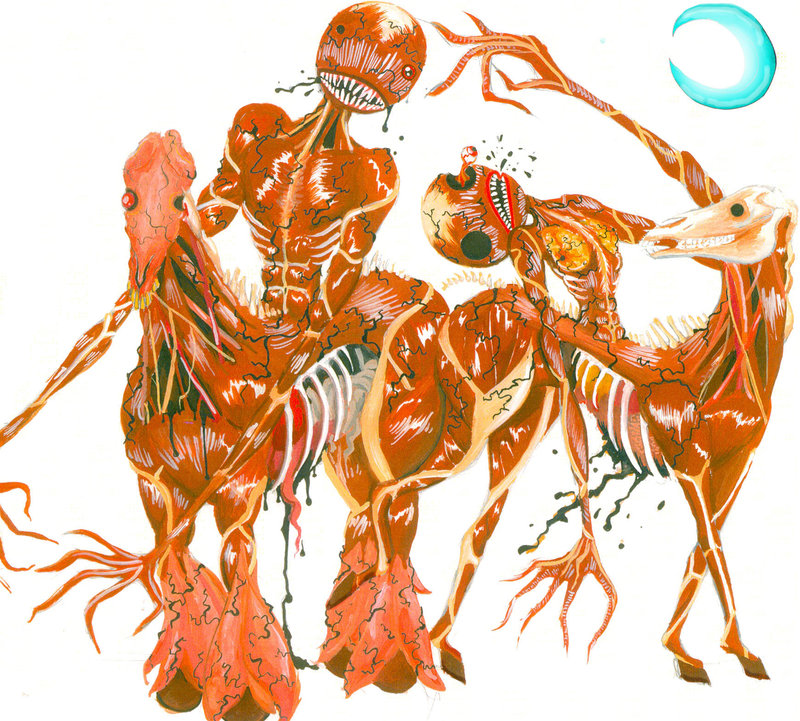
Image from FrankieMileShow
The Nuckelavee
The nuckelavee is a faerie hailing from the folk tales of Scotland. It has the appearance of a man riding a horse, but the man is fused to horse at the hip, and it has no skin, only layers of veiny muscle and flesh. Some stories say that either the man or the horse only have one eye, or that instead of hooves, it has fins like a fish. The nuckelavee lives in the ocean, coming out only to spread a horrible disease called Mortasheen, which decays crops and kills farm animals, specifically horses, and chase men and women through the land. The nuckelavee cannot cross fresh water, such as lakes or rivers.
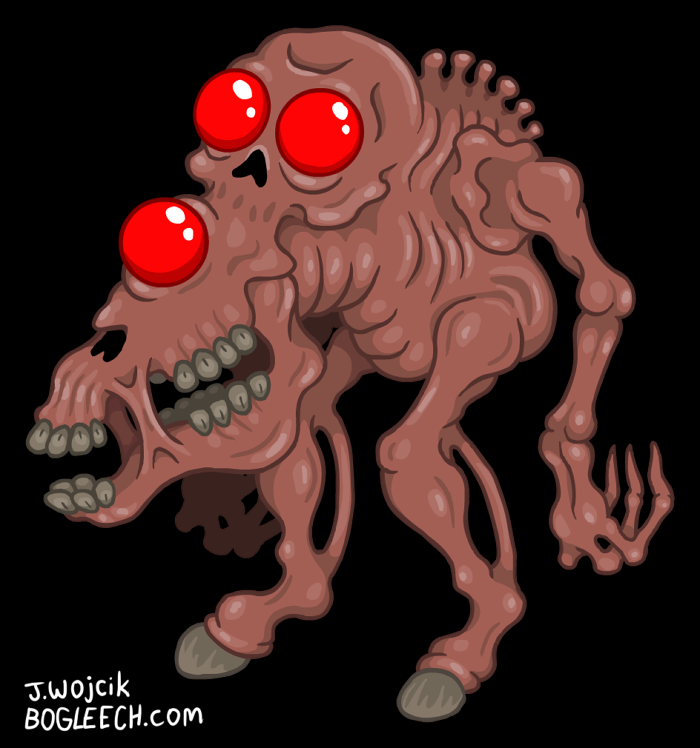
Image from Jonathan Wojcik of Bogleech.com
The Nuckelavee for Labyrinth Lord
Note: I use the ascending AC system made by The Lizard Man Diaries for Labyrinth Lord. The number in parenthesis after AC is the number you have to hit to attack the creature. I also separate attack bonus from hit dice.

No. Enc.: 1
Alignment: Chaotic
Movement: 200' (66')
Armor Class: -1 (21)
Hit Dice: 7
Attacks: 3 (hoof/bite/claw, +5 hoof/claw, +3 bite)
Damage: hoof: 2d6, bite: 1d8, claw: 2d6+1
Save: MU19 (see below)
Morale: 12

The nuckelavee will either attack using a combination of the three attacks above, or they will release a cloud of the Mortasheen pestilence. Every creature around the nuckelavee must make a save vs. breath attacks or be caught in the diseased cloud. Every creature caught in the cloud takes an amount of damage equal to the current hit point total of the nuckelavee. A successful save vs. poison or death makes the attack deal half damage, rounded up. They also take 1d10 damage each round while still in the cloud, and 1d6 each round they are out of the cloud. Making a save vs poison or death halves the damage from the 1d10 while in the cloud, and makes you not take any more Mortasheen damage when outside of the cloud. A nuckelavee takes double damage when hit by an iron or iron-based weapon, and they take 1d6 damage when hit by salt. A nuckelavee can make a save vs. poison or death to halve the damage, rounded down. They save equal to a level 19 Magic-User, with the following exceptions: They have a breath attack save of 4, and a poison or death save of 14. The nuckelavee will run disappear or run away if hit many times by iron or salt, or if the characters cross a body of fresh water. It can be turned by clerics.
Image from savagepassion666
The Nuckelavee for DnD 5e
The stat block for the nuckelavee for end 5e is forthcoming.